
A piercing is more than just a piece of jewellery. It sits in direct contact with your body, often for years, which makes choosing the right material just as important as choosing a design you love.
Unfortunately, not all jewellery that looks high quality is actually suited for long-term wear in a piercing.
One example we regularly encounter at Dodeka Ink is coated jewellery. Think gold-plated pieces or jewellery given a black, gold or coloured finish using PVD or another surface coating.
They may look great at first, but underneath that colour can be a material you wouldn’t necessarily want sitting inside your piercing.
So what exactly is the problem with coated piercing jewellery, and what should you choose instead?
What is coated piercing jewellery?
Coated jewellery consists of a base material covered by a thin outer layer that changes its colour or appearance.
A gold-coloured piece, for example, doesn’t necessarily have to be solid gold. It might simply have a thin gold-coloured layer over another metal. Black and other coloured jewellery can similarly be produced using techniques such as PVD coating.
And that’s where an important distinction comes in.
The surface you see when you buy the jewellery is not necessarily the surface your piercing will be exposed to forever.
Coatings can gradually wear down through friction, moisture and everyday use. Once that happens, the base material underneath can become exposed.
Why can coated jewellery cause problems?
There are a few reasons we’re cautious about using coated jewellery in piercings, particularly while a piercing is still healing.
1. The coating can wear away
A coating isn’t necessarily permanent.
Your jewellery comes into contact with skin, moisture, clothing, bedding and plenty of tiny movements every single day. Over time, this can affect its surface.
Once the coating starts wearing away, the material underneath is exposed.
If you don’t know exactly what that base material is, you also don’t know what is coming into prolonged contact with your piercing.
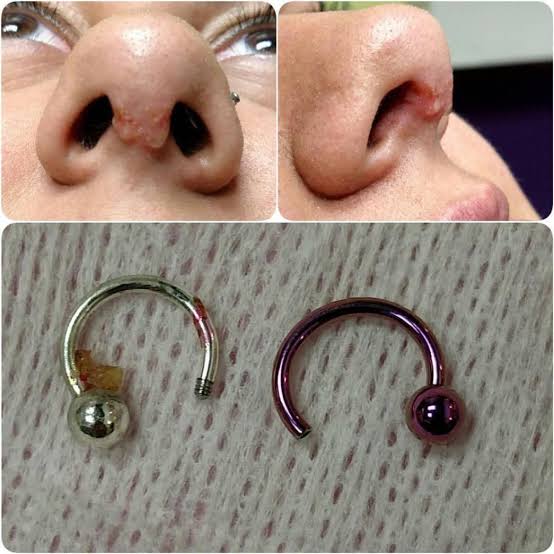
2. The surface can become less smooth
Good piercing jewellery should have a smooth, highly polished surface.
When a coating becomes damaged, scratched or starts to deteriorate, that surface may become less uniform. This can introduce additional irritation, particularly in a piercing that is still healing.
And healing piercings don’t exactly need extra reasons to become irritated.
3. You’re often buying the colour, not the material
A piece being advertised as “gold”, “rose gold” or “black” tells you very little about what the jewellery is actually made from.
That’s why we think the question shouldn’t just be:
“What colour is it?”
It should be:
“What material is underneath it?”
For body jewellery, material quality and surface finish matter more to us than simply achieving a certain colour.
What about PVD-coated piercing jewellery?
PVD deserves a little extra explanation because you’ll see the term frequently when shopping for piercing jewellery.
PVD stands for Physical Vapour Deposition. It’s a process used to apply a very thin surface layer to another material.
That doesn’t automatically mean every PVD-coated object is “bad”. The important question for piercing jewellery is what material is underneath the coating, how the piece has been manufactured, and whether it is appropriate for the particular piercing and stage of healing.
For a fresh or healing piercing, however, our preference is simple: use jewellery made from appropriate materials without relying on a decorative coating as the surface that sits inside the piercing.
What materials do we recommend instead?
Rather than choosing jewellery primarily because of its coating, look at what the piece itself is made from.
At Dodeka, one of our main choices for piercing jewellery is implant-grade titanium.
Implant-grade titanium
Titanium is lightweight, durable and available in jewellery specifically manufactured for body piercing.
And if you want something other than silver?
Titanium can also be anodised.
Anodising changes the way the surface of titanium reflects light rather than covering it with a layer of coloured paint or plating. This makes it possible to create colours such as gold, bronze, purple and blue without adding the type of decorative coating we’re talking about in this article.
Solid gold
If you’re looking for actual gold jewellery, we’d rather see you invest in a suitable piece of solid gold than a cheaper piece that’s simply gold-plated.
Quality solid-gold body jewellery gives you the warm colour people often want from plating without depending on a thin outer coating.
Not every gold alloy is automatically suitable for body piercing, though, so buy jewellery specifically manufactured for this purpose rather than assuming any gold earring or piece of jewellery is suitable for a piercing.
Niobium
Niobium is another material used within professional body piercing and can be a particularly interesting option if you’re looking for dark jewellery without relying on a conventional black coating.
But my coated jewellery has never caused a problem
That’s completely possible.
Bodies are different, piercings are different and not every person wearing coated jewellery is automatically going to experience irritation.
Our concern is more about reducing avoidable variables.
When we’re dealing with a new piercing, we’d rather start with a material and surface finish we trust than wait to find out whether a coating is going to hold up well in that particular piercing.
It’s the same reason we pay attention to jewellery size, shape, polish and fit.
Good piercing jewellery isn’t just about preventing an obvious reaction. It’s about creating the best possible conditions for your piercing to heal.
Could your jewellery be causing your piercing irritation?
This is something we regularly look at when someone visits Dodeka with a piercing that simply doesn’t seem to settle.
Redness, irritation, swelling or recurring crusting can have many possible causes. Jewellery material can be one of them, but so can inappropriate sizing, pressure, movement, placement or aftercare.
So rather than immediately assuming your piercing is infected or that your body is “rejecting” jewellery, it can be worth having the whole situation assessed.
Sometimes something as straightforward as changing the jewellery can make a big difference.
Quality jewellery is worth the investment
Good piercing jewellery is understandably more expensive than mass-produced plated jewellery.
But you’re not only paying for its appearance.
You’re paying for the material, manufacturing, surface finish, longevity and suitability for body piercing.
A €10 gold-coloured piece that needs replacing repeatedly isn’t necessarily better value than quality jewellery that you can comfortably wear long term.
And when it’s going to sit inside your body, we think that’s one of the places where quality really matters.
Piercing jewellery at Dodeka Ink Tilburg
At Dodeka Ink, we want jewellery to look beautiful, but appearance never comes before safety and quality.
That’s why we’re selective about the materials and manufacturers we work with and why we don’t choose jewellery for a fresh piercing purely because a certain coating creates a nice colour.
Already have a piercing that isn’t behaving the way you’d expect?
You’re always welcome to come by the studio in Tilburg and let us take a look. We can check the jewellery, fit and piercing and talk you through what might be going on rather than simply guessing.
And if you’re simply looking for something new, you can browse our piercing jewellery in the webshop.